
ABP.io
Jumpstart your .Net development with a mature, tested, reliable framework with strong community support.
ABP.IO FRAMEWORK
Rapid development for .NET
.NET and Angular accelerators that strengthen security, code quality, and delivery speed from day one—featuring standardized architecture, generators, UI shell, CI/CD, and observability, optimized for Azure and on-prem deployments.
What's included
Starter kit, code generators, and governance guardrails.
-
Clean architecture templates
-
Auth (Entra ID), RBAC, secrets
-
Testing harnesses & API contracts
-
Observability (logs, metrics, traces)
Key modules
-
Account module
-
Audit logging
-
CMS Kit
-
Payment module
-
Saas / Tenant management
-
Permission management
Key outcomes
Faster starts, fewer regressions, cleaner handoffs.
-
Releases in weeks, not months
-
Consistent clean architecture patterns
-
Security, logging, and quality gates in every repo
-
Lower TCO with shared templates and re-usable components
Additional modules
-
GDPR module
-
File management module
-
Forms management
-
Real-time messaging
-
Language management
-
Identity management
ABP.io architecture
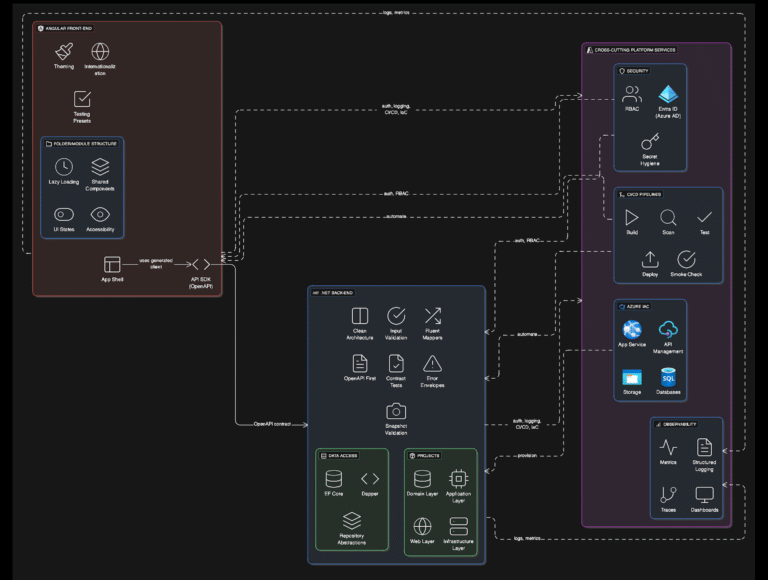
The architecture is composed of three primary, scalable components: a .NET back-end, an Angular front-end, and cross-cutting platform services, all automated via CI/CD pipelines.
.NET web API foundations
Clean architecture with boundaries that scale.
- Projects for domain, application, infrastructure, and web layers
- EF Core patterns, Dapper option, and repository abstractions
- Input validation, fluent mappers, and standardized error envelopes
- OpenAPI-first with contract tests and snapshot validation
Cross-cutting platform services
Security, quality, and operations from day one.
- Entra ID (Azure AD) auth, RBAC, and secret hygiene
- Structured logging, metrics, traces, and dashboards
- CI/CD templates: build, scan, test, deploy, smoke-check
- Azure-ready IaC: app service, API mgmt, storage, databases
Angular app shell
Scalable UI patterns with generator-backed modules.
- Opinionated folder and module structure with lazy-loading
- Shared components, UI states, and accessibility-first design
- API SDK generated from OpenAPI with typed clients
- Internationalization, theming, and testing presets